
In recent months, landmark policies have accelerated the shift toward electric vehicles (EVs) in Delhi, among the highest-polluting capitals in the world. EV Policy 2.0 introduces one of India’s most ambitious electric mobility roadmaps, phasing out new registrations of internal combustion engine (ICE) three-wheelers and N1 goods carriers (commercial cargo vehicles weighing up to 3.5 tonnes) by January 2027, and ICE two-wheelers by April 2028.
Additionally, a first-of-its-kind program encourages the replacement of BS IV (Bharat Stage IV) and older trucks and buses registered in Delhi’s National Capital Region (NCR) with BS VI or stricter emission-compliant vehicles, and with EVs where feasible, supported by financial incentives. Bharat Stage (BS) standards are India’s vehicle emissions norms, closely modeled on the EU’s Euro standards.
EVs are no longer a suggestion in Delhi; they are a requirement. For years, ICCT has worked to provide the technical foundation for clean vehicle policies in India, engaging with policymakers and the media to support progress.
ICCT’s research provided critical analytical support for EV Policy 2.0. Its TRUE study of real-world vehicle emissions in Delhi and Gurugram found that ICE N1 goods vehicles and three-wheelers are among the highest real-world emitters, and that ICE two-wheelers are a major contributor to overall transport emissions and population exposure—justifying the policy’s focus on these specific segments. The study recommended a supply-side zero-emission vehicle (ZEV) sales mandate. Follow-on analysis showed that electrifying two- and three-wheelers was financially viable for owners, and a life-cycle assessment conducted jointly with the Indian Institute of Technology (IIT) Roorkee demonstrated that battery electric vehicles outperform strong hybrids environmentally.
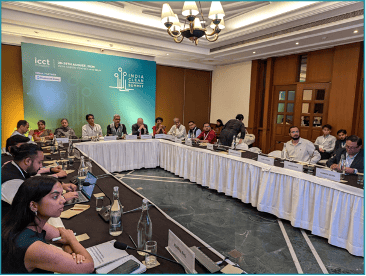
ICCT’s research also supported the vehicle replacement scheme. The TRUE study showed that BS VI compressed natural gas (CNG) buses cut emissions by nearly 85–95 percent across pollutants compared with BS IV buses, and found that real-world nitrogen oxides from BS VI CNG light-goods vehicles ran roughly 14 times higher than type-approval limits (type approval is the legal certification a vehicle must pass before it can be mass-produced and sold). This finding provided the foundation for the requirement that Delhi’s replacement light-goods vehicles go fully electric.
The ICCT communicated this research directly to policymakers, including the Commission for Air Quality Management (CAQM), the Delhi Transport Department, the Ministry of Road Transport and Highways, and the Central Pollution Control Board.
The ICCT also offered critical analytical support for the supply-side ZEV sales mandate in EV Policy 2.0 in Delhi-NCR discussions, providing research showing that the scale of pollution demanded drastic action.
In addition, the ICCT’s work supported greater policy ambition. ICCT analysis demonstrated that public incentives should be reserved exclusively for ZEVs, countering stakeholders who wanted incentives extended to hybrids. The final policy excluded hybrid incentives, and government analysis cited the ICCT-IIT Roorkee study.
Delhi is now a model for others to follow in the EV transition. But the work isn’t finished: Delhi’s ZEV ambition risks hitting a charging bottleneck, and the ICCT has proposed a right-to-charge framework, modeled on Norway and the EU, as essential infrastructure for mass adoption. Beyond Delhi, the ICCT is working to advance a range of innovative vehicle policies at the local, regional, and national levels to support India’s accelerating transition to a clean transportation future.