

Crux Alliance members launch Grid Policy Toolkit ahead of COP31
As electricity demand grows and solar and wind reshape power systems, aging grids are becoming the main constraint on the energy transition. At COP31, countries are expected to adopt a global electrification target, and grids will determine whether it can be met.
The Grid Policy Toolkit is a first-of-its-kind resource that brings power, industry, transport, and buildings expertise together in a single guide to grid modernization. It gives policymakers, regulators, and planners 27 recommendations and good practices from Europe to Southeast Asia, showing what each sector needs from the grid and how each can make the system cheaper to build and run.
The toolkit is the first project to bring all Crux Alliance members together, the result of a year of collaboration. Members are now working to put it into practice country by country.

Nigeria advances industrial energy efficiency with new motor standards
Industrial motors are the backbone of industry, powering manufacturing processes behind everything from cement and steel production to food processing and textiles. Improving their energy efficiency presents a major opportunity to reduce electricity demand, cut emissions, and lower operating costs for factories. In Nigeria, the industrial sector accounts for over 20 percent of electricity consumption, roughly the equivalent of Belgium’s annual total.
CLASP partnered with the Standards Organization of Nigeria on an efficiency policy for several types of electric motors, adopted this October as part of the country’s broader ambitions to achieve net-zero emissions by 2060 and lift 100 million people out of poverty. The policy will avoid over 6 million tonnes of CO₂ emissions and sets the stage for broader ambition on motors systems efficiency in the country.
This policy is a major milestone in CLASP’s global effort to improve motor systems efficiency. Energy-efficient motor systems can lower national electricity demand and reduce the need for costly generation, transmission, and distribution investments. When governments are able to avoid these expenses, that capital becomes available for industry, education, healthcare, and infrastructure, which ultimately helps to drive GDP growth. At a local level, efficient motors can also reduce operational costs for small businesses and smallholder farms. Lower costs translate to improved profitability and a stronger economy.


Taking India’s residential energy code digital
States across India can now begin adopting a digital platform that integrates compliance with residential energy efficiency requirements into building approval processes.
India will construct roughly 70 percent of its 2030 building stock in the coming years, locking in energy consumption patterns for decades. Until now, states have lacked the tools, technical capacity, and standardized workflows to consistently enforce Eco Niwas Samhita (ENS) 2024, India’s residential energy code, meaning compliant buildings were the exception rather than the rule.
The new digital platform now embeds energy efficiency checks into building approvals, helping routinize compliance, reduce energy waste, and curb emissions. Developed collaboratively by the Bureau of Energy Efficiency (BEE) and the Ministry of Power with GBPN, the National ENS e-Compliance Platform allows states to align compliance workflows with their own regulations and city government procedures. Government representatives from 11 states and union territories were among 180 participants who attended an October 2026 consultation in New Delhi. GBPN will continue working with BEE and engaging regional governments to support state adoption.


Agora analysis shows green iron trade can support jobs and growth on both sides of the market
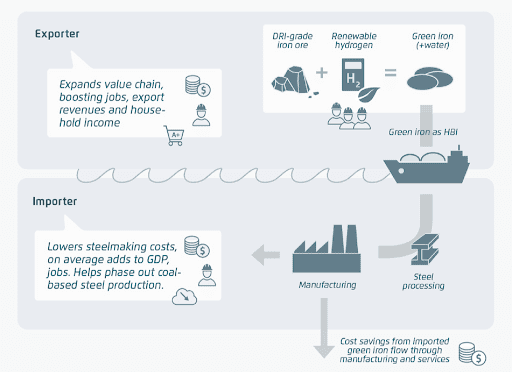
Green iron trade could create new industrial centers and help decarbonize established steelmaking economies. A new Agora Industry study, based on Cambridge Econometrics modeling, is the first to quantify the economic effects across 10 potential green iron exporters and importers.
Countries with abundant renewable energy could build new export industries, while established steelmaking economies could use green iron imports to sustain downstream manufacturing and jobs. For example, by 2050 Brazil could gain up to $40 billion in GDP and over 400,000 jobs through higher-value exports, while integrating green iron imports into South Korea’s low-carbon steel production could add up to $34 billion to its GDP and create around 340,000 jobs. Green iron trade could also reduce global iron and steel sector emissions by 36 percent between 2025 and 2050.
The analysis gives policymakers a quantitative basis for aligning industrial, energy, and trade policies to capture these shared gains and identifies practical priorities: investment in renewable energy and hydrogen infrastructure, long-term purchase agreements, and strategic international partnerships. Agora is now engaging policymakers and stakeholders at the country level to bring recommendations into bilateral cooperation discussions and build support for concrete steps toward green iron trade corridors between Japan-Australia and Brazil-Germany.

Agora connects Southeast Asian policymakers with international energy transition experience
Southeast Asia’s energy transition depends on integrating renewables into power grids while building competitive, low-emission industries. Agora’s strong presence at Bangkok Climate Action Week helped connect regional policymakers and stakeholders with practical lessons from around the world, including Europe and the Asia-Pacific region.
Agora’s full-day Flex and Trade event, co-hosted with the International Network of Energy Transition Think Tanks, convened more than 40 policymakers and representatives from business, multilateral development banks, and civil society to explore power system flexibility and how to scale battery storage. Conversations focused on when requiring batteries to be co-located with renewable energy projects could support grid integration, and when it might increase costs without additional benefits. An interactive game demonstrated how policy design can effectively reward the full range of grid services that batteries can provide.
The exchanges highlighted priorities for Southeast Asian policymakers, including assessing flexibility needs and enabling battery storage, grounded in practical international experience and regional examples.


ITDP Mexico’s MOVIN Program shows how employers can help transform urban mobility
ITDP Mexico recently concluded its MOVIN Reforma program, a pioneering initiative to promote sustainable mobility along Paseo de la Reforma, an iconic avenue in Mexico City. As part of the program, major employers along the Reforma business corridor, including AT&T Mexico, BBVA Mexico, and Grupo Kaluz, introduced sustainable mobility promotions such as bike-share memberships, cycling education, public transport incentives, corporate shuttles, carpooling programs, and hybrid work policies. Together, these measures encouraged employees to choose more sustainable ways to travel to their offices on Reforma. The results highlight the private sector’s key role in empowering sustainable mobility.
Launched in 2019 and formalized in 2022 with support from public officials, MOVIN’s Institutional Mobility Plan showed that when public-private partners work together, they can achieve tangible reductions in car dependency, emissions, and related impacts. Over several years, MOVIN helped reduce employee-travel emissions by 30 percent and cut private car use by 32 percent, while bicycle trips doubled. As cities and businesses look for practical ways to address emissions, health, and road safety, MOVIN offers a compelling collaboration model.


California mandates electric truck price transparency, driven by ICCT research
In 2025, ICCT analysis found that U.S. prices for Class 6+ battery electric trucks have steadily risen, while prices fell in other major markets. These findings sparked a push for new price-transparency legislation in California when advocates took it up. The Natural Resources Defense Council cited the study in a piece calling for price transparency, and secured State Senator Eloise Gómez Reyes’ agreement to sponsor a bill. The senator’s staff invited ICCT’s technical expertise on price transparency, and both the senator’s and the Environmental Quality Committee Chair’s summaries cite ICCT analysis.
This September, California Governor Gavin Newsom signed SB 1213, which makes price disclosure of electric trucks a condition of eligibility for California incentive programs. The new law addresses a core market shortcoming: plenty of incentive dollars but rising prices, reflecting legacy truck manufacturers’ pricing power. Greater transparency will give buyers negotiating leverage and put downward pressure on prices.
The ICCT’s research drove the outcome. Transparency alone won’t replace supply-side regulation, but further measures—such as eliminating commercial EV sales taxes, residual value guarantees, and bulk-purchase incentives—can stimulate further progress.

New rules support clean hydrogen progress in Brazil
Brazil has taken an important step toward implementing its low-carbon hydrogen framework by establishing rules for subsidy auctions and tax incentives. Agora Industry, together with Brazilian partner E+ Energy Transition Institute, has contributed to shaping the national hydrogen debate from an early stage. The 2024 Agora report, 12 Insights on Hydrogen—Brazil Edition, helped focus attention on “no-regret” applications, particularly hydrogen as an industrial feedstock and reducing agent, as well as in aviation and maritime transport. Agora Industry followed up with deeper Brazil-specific analysis on green iron, ammonia, and methanol.
The 2024 Brazilian Low-Carbon Hydrogen Development Programme provides roughly EUR 3 billion in fiscal credits for 2030–34, but with hydrogen costs still high, it is more important than ever to focus support on high-potential applications such as fertilizers and sustainable aviation fuel (SAF). Together with E+ and ICCT, Agora Industry is considering bringing this analysis into discussions on the upcoming tender rules for Brazil’s first clean hydrogen auction, expected in 2027, including international experience such as the H2Global market mechanism and evolving support and certification frameworks for SAF.

Demonstrating the ever-growing value of heat pumps
Crux partners have been demonstrating the increasing worldwide value of heat pumps as solar and batteries have become cheaper and as demand for cooling has grown. Alliance members’ coordinated efforts on this vital technology continue to make demonstrable progress, with heat pumps explicitly referenced in the Antalya Compact on clean buildings set for national government endorsement at COP31.
Each partner adds something different. RAP has set out the benefits for Italy, has worked on cost-optimal subsidy design, and will soon publish research on the value of heat pumps in the southern U.S. Agora is assessing which heat pumps and configurations deliver most benefits across Europe’s building stock. GBPN has taken the agenda into warmer climates with a global webinar for partners from Southeast Asia, India, and Australasia. CLASP pulls the work together with expertise on clean refrigerants and appliance efficiency, including standards work in China covering both air conditioning and heat pumps.