
New research from the Institute for Transportation and Development Policy (ITDP) and the University of California, Davis, supported by the FIA Foundation, finds that transforming the way people move in cities could significantly reduce countries’ dependence on imported oil and gas and strengthen resilience to volatile global energy supply.
The report, Compact Cities Electrified: Energy Outlook, analyzes Brazil, China, India, Indonesia, Mexico, and the United States, representing nearly half of the world’s population and a range of oil and gas producers and importers. The research examines how different combinations of vehicle electrification and shifts toward public transport, walking, and cycling could affect energy demand and fossil fuel imports through 2050. The findings are significant: pursuing electrification and mode shift together could cut energy use from urban passenger transport by around 70 percent and liquid fuel demand by 85 percent by 2050. The combined approach could also reduce gross oil and gas imports by between 11 percent and 57 percent, depending on the country, amounting to approximately 2.5 billion fewer barrels of oil equivalent imported each year across the six countries compared with business as usual.
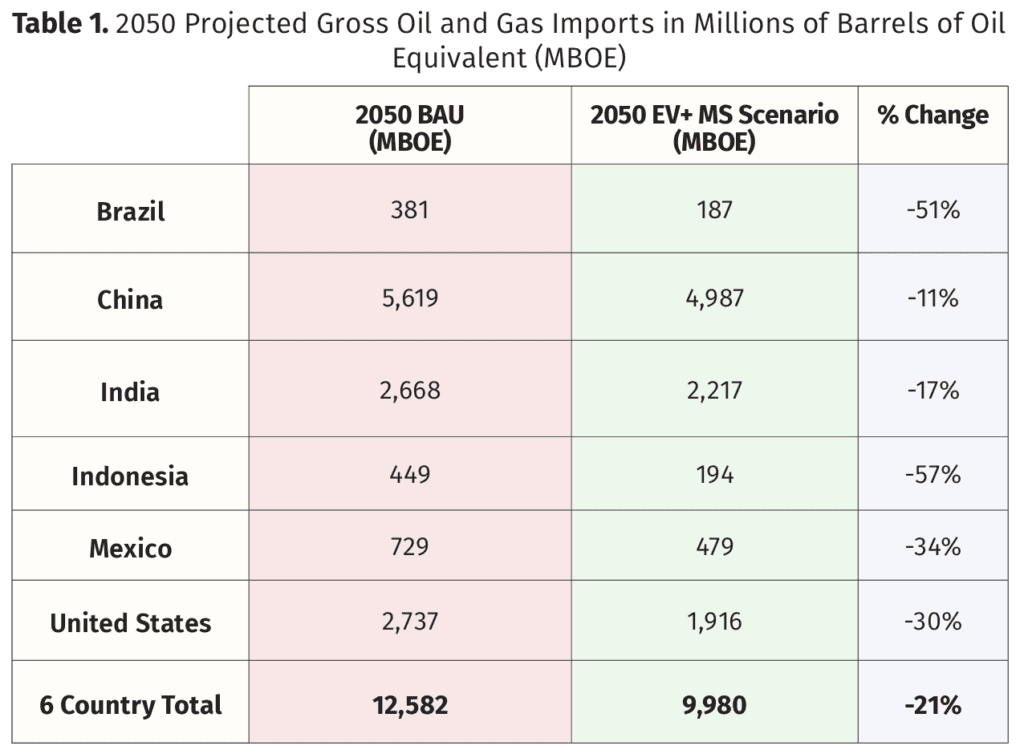
Crucially, the analysis highlights that electrification alone is not enough. The greatest energy-security benefits come when countries electrify vehicles while simultaneously reducing dependence on private cars by making public transport, walking, and cycling more attractive and practical. Electrification and mode shift also reinforce each other: progress in one can help protect countries when progress in the other falls short.
The economics of that transition are also changing. While global oil and gas markets have been volatile, battery costs have fallen by more than 90 percent since the early 2010s, strengthening the financial case for transport electrification. From short-term relief to long-term energy security. The report argues that governments facing high fuel prices have a fundamental policy choice: temporarily shield consumers through fuel subsidies or invest in structural measures that reduce fuel demand.
Fuel subsidies may provide immediate price relief, but they also encourage continued fossil-fuel consumption, strain public finances, and leave countries exposed to the next price shock. They can also disproportionately benefit wealthier households that consume more fuel. By contrast, investments in electric mobility, public transport, walking, cycling, and compact urban development permanently reduce the amount of oil required to move people and economies.
The benefits extend beyond energy security.
Previous modeling underlying the analysis finds that a system of safe, shared electric mobility could save governments USD $600 billion, reduce urban passenger PM2.5 air pollution by 67 percent, and prevent 170,000 road deaths annually by 2050.
ITDP works with governments to prioritize policies that support compact, mixed-use cities; expand high-quality public transport; build safe walking and cycling networks; manage private car use; accelerate vehicle electrification; expand charging infrastructure; and implement measures such as aggregated procurement and zero-emission vehicle standards to bring down costs.